
HEAD MA FASHION 2026: CELEBRATION AND CONTRADICTION
By 1 Granary Team
Fiona Giazzi
“My collection starts with the idea of a sense of self and the act of mourning as a form of celebration. I wanted to create different looks that contain different stories and meanings at the same time, but are still linked together. Mourning is not only about a person. It’s also about forgotten memories, losing yourself and recomposing the fragments. I took inspiration from my own wardrobe and my family memories. In terms of design, I focused on the 19th century for the shoulder shapes and technical aspects.”
Hippolyte Laporte
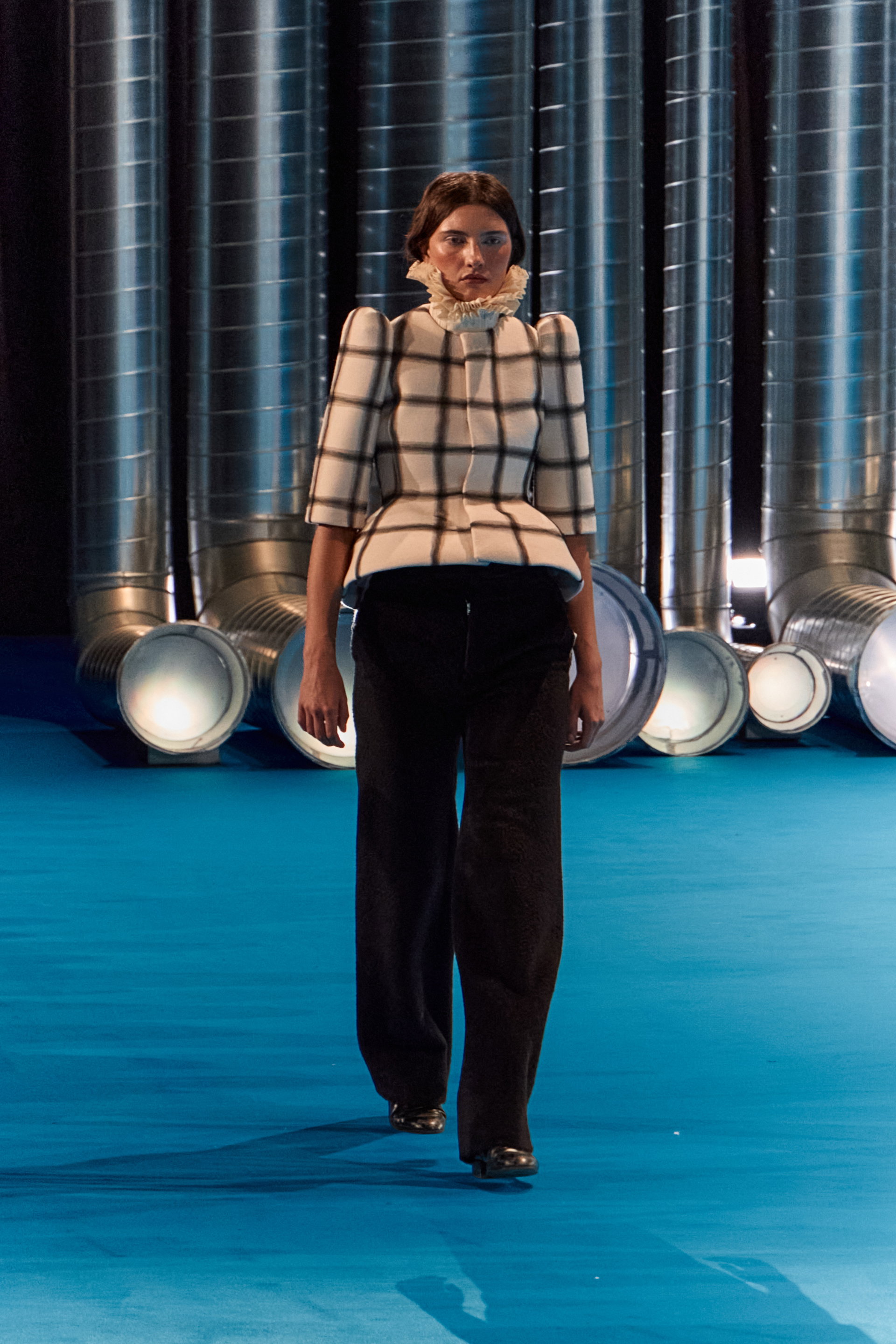
“‘Anamorphoses’ explores the preparation for a bourgeois dinner, where the desire to conform to social expectations gradually gives way to play, imagination and transformation. The collection contrasts a strict, tailored wardrobe with surreal silhouettes. The bourgeois wardrobe is treated like a theatrical costume and given an artificial feel through the use of techniques such as trompe-l’œil. Through this shift, clothing becomes a space for self-expression rather than social integration. Ultimately, the collection is a tribute to sewing, the joy of making and intimate spaces as places of freedom, creativity and transformation.”
Baptiste Blanchard
“My graduate collection, ‘RE: PLAYTIME’, takes inspiration from the familiar expressions ‘turning the page’ and ‘writer’s block’. Both connect to paper, which becomes my starting point for exploring the creative process. Inherent in the act of turning the page is the idea of starting all over from scratch. I reuse ordinary, functional garments, transforming them through the gestures of turning, folding and unfolding a page. Familiar clothing elements are opened and flipped, allowing garments to shift between their original function and new forms. For me, a sheet of paper represents a space of dreams and possibilities: a starting point for sketching, reading, writing and communicating ideas. The collection explores this through cutting, folding and construction, balancing wearability with more conceptual silhouettes.”
Jeanne Albertine Milani
“My MA collection, ‘Out of the Closet’ explores lesbian dressing history through my personal perspective and the observation of how my own queer community dresses. Inspired by Eleanor Medhurst’s Unsuitable and the authors Joan Nestle and Leslie Feinberg, I reinterpret historical dressing archetypes through contemporary silhouettes, creating my own queer wardrobe. Knitwear is at the heart of my practice, allowing me to translate visual references into textile experiments. Working mainly with deadstock and locally sourced materials, I explore techniques such as pinstripe knitting, felting and reverse-side constructions for my collection. Combined with tailored pieces, these experiments create a wardrobe celebrating the multiplicity of queer expression and the joy of be(com)ing through dressing.”
Flurina Vieli
“My collection ‘Starring’ explores clothing as a storytelling medium shaped by personal desires, memories and identities around clothing. Developed through conversations with models and friends, the garments fuse their narratives with the designer’s interpretation. Rather than presenting clothing as a fixed object, the project investigates its subjective nature and the diverse meanings garments can hold for different individuals. The participants’ ideas, habits and narratives informed the designs, while the designer’s own interpretations shaped their material realisation. Using paper and paper-like textiles, the process emphasised experimentation and visible traces of making. Inspired by Ursula K. Le Guin’s The Carrier Bag Theory of Fiction, the project treats garments as containers of shared stories, fostering a collective and relational approach to fashion.”
Lou Gattlen
“This collection is all about the handle: how we hold things, how the handle interacts with objects, how we interact with handles and how we carry things. In the research, the narrative shifts from handles as purely functional elements to understanding them as the main actors, as decisive factors in determining the volume of bags. The handles determine the shape of the bags, enabling transformation and the functionality that goes with it. Another key element of my research and the collection lies in transformation, the transition from one state to another. I am interested in the change and, at the same time, the similarity between the stages.”
Tanguy Mélinand
“My collection, ‘MUDDY SEA: LandscapeCore’, explores memory: the places, sensations and moments that remain within us despite distance and the passing of time. Having grown up in Landéda, a small coastal village in Brittany, I draw on the landscapes that shaped me, exploring their atmospheres, colours and textures. Through my collection, I reinterpret these environments through clothing, particularly workwear, sportswear and outdoor garments, borrowing their codes, forms and functional details. Textile development plays a central role, combining material experimentation, garment dyeing and biomaterials, including seaweed leather. A palette of faded pastel tones evokes nostalgia, while each garment carries fragments of personal history. Ultimately, ‘MUDDY SEA’ is a love letter to my upbringing, my adolescence, my friends and the landscapes that continue to live within me.”
Catarina Santos Moreira
“In my collection, ‘OVERWORKED: bags to share the load’, I aim to highlight and celebrate forms of labour that are often precarious, underpaid and undervalued, predominantly performed by women, particularly immigrant women and those from minority groups. Rooted in my family history and Portugal’s collective experience of agricultural labour and survival, the project explores the weight of work, emotions and expectations. Drawing on everyday containers, from plastic bags and mop buckets to the traditional Portuguese cântaro, I transform familiar objects into statement accessories. The pieces are crafted in leather, using exclusively deadstock materials, meaning each design is shaped by the materials I find, their available quantities and their existing characteristics. Through a performance, an initially concentrated burden is gradually redistributed between several bodies, proposing a collective approach to carrying the load.”
Anna Backdahl (ANBK)
“‘How do you like me now?’ is a project about my Swedish heritage, hypersensitivity and the notion of belonging. By merging archetypes I grew up with, I deconstruct and reconstruct second-hand garments through the lens of a hypersensitive woman, creating sustainable fashion with inclusivity at its core.”
Omar Amorim Esenli
“The collection ‘Numéro Vendeur 4’ was born during 11 months of‘civilian service at [charity and secondhand shop] Emmaüs Genève, a place I came to see as capitalism’s purgatory, where discarded objects linger between abandonment and a second life. The collection explores the seductive yet violent contradictions of labour: volumes swell where the body aches from work, and H. R. Giger-inspired accessories evoke alienation through labour. At its heart lies the knot, worked in macramé with artisan Leonardo Martines from deadstock [AirPod] cables. The knot binds and restrains the body, yet it also connects materials, stories and flaws until they hold as one. My silhouettes live in this tension. Above all, the collection pays tribute to Natia and Patricia, with whom I worked during my civilian service.”
Tim Kaiser
“Working in different ateliers, I became increasingly aware of a contradiction: while the garments are celebrated and displayed, the spaces and people involved in making them often remain invisible. The atelier is hidden behind the finished product, even though it is where the garment truly comes into existence. This collection stems from a reflection on and a dissection of the Western European atelier as both a physical and symbolic place of creation, as well as an important and formative place in my professional career. I was inspired by the contrasts between rawness and refinement, between the cut pattern pieces and the leftovers, and between process and finished product.”