Home / Editorial / About

All posts in Louise Wilson

It’s A Boy/Girl Thing: Interview with MA Fashion Graduate Elena Crehan

For her MA final collection menswear designer, Elena Crehan, took androgyny to the limits by dressing her male models in fishnets, brogues and fluffy jumpers. Taking inspiration from the fabrics and silhouettes found in sports such as rugby and football, Elena created textured monochrome sweatshirts shot through with streak of yellow resulting in one of the most creative and edgy collections of the MA fashion week show. It was the unexpected and inventive use of lace which really made this collection stand out and forced the audience to ask important questions about what being ‘gender appropriate’ means when it comes to clothing.

What inspires you?

I get inspiration from everywhere…museums, books, films, art, stories. I have very eclectic taste.

Please tell us about your collection.

For my MA I wanted to use lace in a way that had not been done before…lace as outer wear. The inspiration originally came from grass growing through football nets but this was a very early reference and the technique really evolved through developing samples. Rugby shirt references informed the stripes and Inuit children dressed in oversized jumper garments informed the silhouette. I wanted it to be bright and bold but as luxurious as possible. I am obsessed with texture so creating a textile that is tactile is always important! When you’re up close with my jumpers or swatch samples its impossible not to touch them!

How did you end up at CSM’s MA course? 

It had been my plan to do the MA at CSM ever since I helped out with Louise Grey’s MA collection when I was about 18. I only helped for a day, cutting out chiffon layers for a multi layered trench coat, but it was enough to tell me it was what I wanted to do.

Did you always want to do fashion design?

I love making stuff and I love clothes! I guess in a way the two merged and that’s when I started wanting to design for fashion.

Tell us about your time on MA. What was the most fun and what was the most difficult?

There is no doubt that doing the MA at CSM is tough. You are pushed physically and creatively the whole time! I’ve made great friends and there have been some great moments as well as some really low points…picking the best and worst is difficult.

In your opinion, what skills are most important for the MA? 

In terms of what skills you need to be fit for the MA, organisation, a thick skin and an easy attitude go a long way. But most importantly you must have a skill, know what it is and use it to its full potential. That skill could be anything, as long as you’re clever with it it doesn’t matter what it is!

What is the most valuable lesson you learnt from Louise Wilson?

To question what I’m doing all the time and to never rely on a good idea…it can always be better! And perseverance is king!

What advice would you give to BA students who want to apply for the MA course?

If you want to apply for the MA course just go for it. Be prepared to fight your corner and make sure you have a USP. That sounds silly but what the tutors are looking for in applicants is something different from everything else they have ever seen, so make sure you show your personal mark within your portfolio.

What advice would you give to BA students who want to apply for the MA course?

If you want to apply for the MA course just go for it. Be prepared to fight your corner and make sure you have a USP. That sounds silly but what the tutors are looking for in applicants is something different from everything else they have ever seen, so make sure you show your personal mark within your portfolio.

Did you do any internships or work in the industry before? What did you get from that experience?

I did heaps of internships before the MA. They are great for teaching you how the fashion industry works. I learnt how to work as part of a team, how to work to a deadline. I also learnt lots about making and crafting garments which has taught me a lot about the possibilities within garment design.

What are the three most important things you learnt in college that shaped you as a designer?

The most important thing I learnt at Saint Martins was to power through. When everything is going wrong you can turn it round, and you can do it in a very short amount of time if you believe in yourself and are willing to work really really hard! Time management was a big learning curve on the MA too, especially making realistic decisions about what you can achieve within the time limit. The ability to know when to stop and move on is really important. Sometimes things just don’t work out and you can waste a lot of time trying to fit a square into a round hole. It’s all in the edit and one of the hardest lessons I learnt on the MA was that sometimes you have to let go of ideas because they just don’t fit!

Would you like to start up your own label or would you prefer to work for another company?

It’s always been my dream to start my own label on a small scale one day. I don’t think its possible yet as I don’t have a penny to my name following the MA but maybe one day…

What’s next for you? 

Now that the course is over, I’m on the job hunt! I’m really not sure exactly what route I plan to take, I just want to be in a creative role whether that’s within a company or on a freelance basis. It’s quite scary as it’s the first time in my life that I haven’t been in education or knowing exactly what I’m doing next week. I’m looking forward to seeing what opportunities crop up.

Runaway images: curtesy of catwalking.com

Street Smarts: An Interview with MA Fashion Graduate Nicomede Talavera

Muslim traditional dress, grounded in the minimal and refined sensibilities of painters Ellsworth Kelly and Lucio Fontana, provided the starting point for MA fashion graduate Nicomede Talavera’s collection. Shown as part of the CSM MA fashion showcase at London Fashion Week, Talavera’s monastic menswear didn’t, in his words, “conform to the stereotypical Westernised male silhouette”, with plenty of dress-length robes and layers, but the rich corduroy textures and monochrome colour palette highlighted a certain simplicity of form that struck us as being quite masculine. His upbringing in Hounslow, west of London and home to a large Muslim population, provided the backdrop and initial inspiration for his collection.
Citing streetwear as a source of inspiration, it seems natural that Talavera would team up with bag purveyor Eastpak, with whom he has worked since 2011. His Spring/Summer 2013 limited collection showed off hyper-sleek backpacks, duffle bags, and carriers, all in luxe black and white leather and waxed canvas, according to Hypebeast. What else is in his future? “Good things,” he promises. We couldn’t agree more. 1 Granary spoke to Talavera about his six years at CSM, from Foundation to the MA.

What does fashion personally mean to you?

Choice.

What inspires you?

For me, inspiration will always come from what I see around me, in the form of sub-cultures, youth movements and streetwear, and textures. It has to be relevant and relatable to people, not just from the pages of a book or walls of a gallery.

Please tell us about your collection. (as much as possible)

The starting point for my MA collection was Muslim boys in London and the way they mix cultural dress with streetwear. Growing up in Hounslow, (an area with a large Muslim contingent), I have always been inspired by this combination of different dress and how layers, extended lengths and minimal shapes can be worn in an effortless and masculine way that doesn’t conform to the stereotypical Westernised male silhouette.

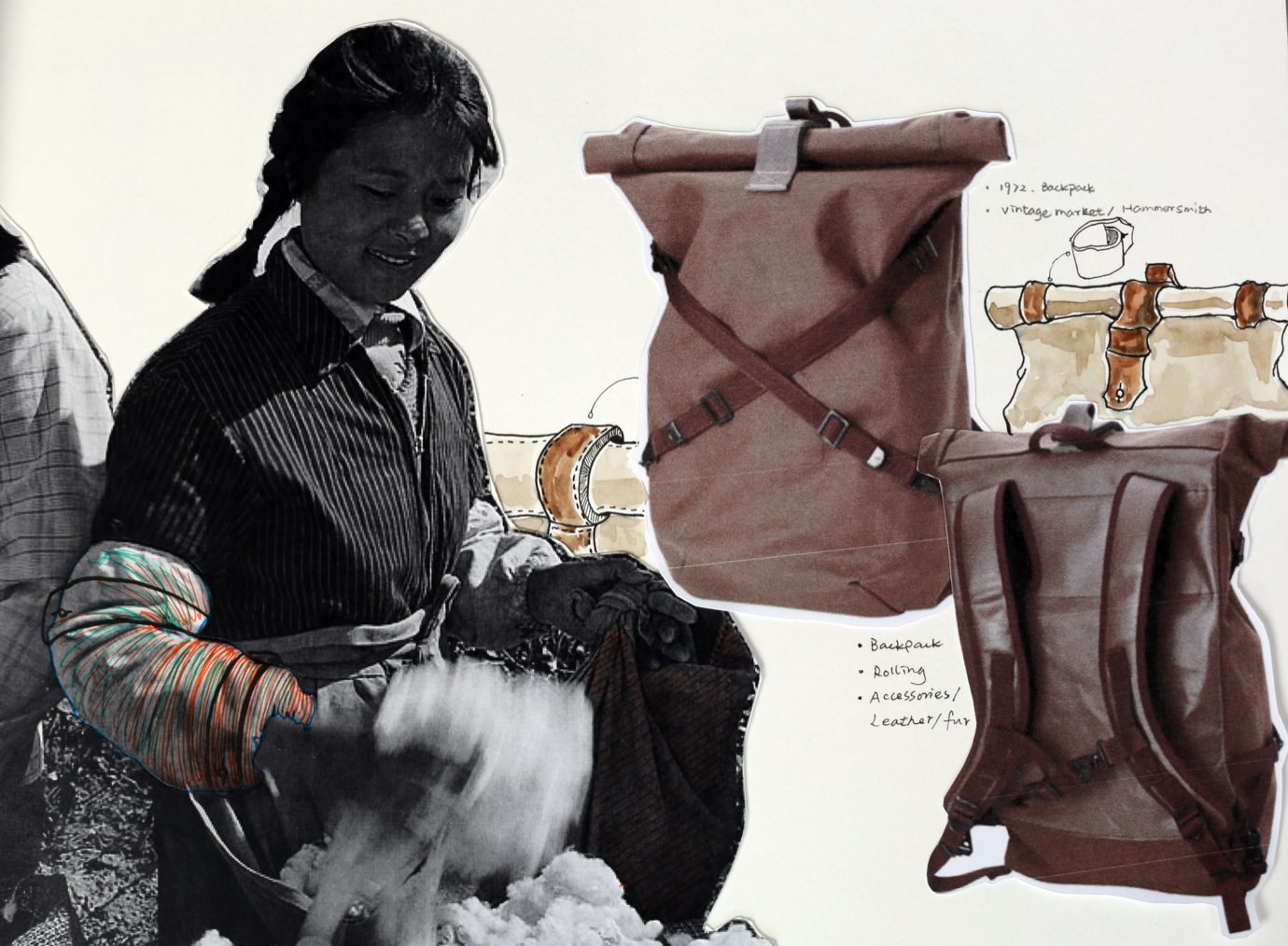
I researched the collection by visiting Whitechapel, Brick Lane, Dalston and Hounslow and recorded the way the boys dressed through photographs and sketches. Simple things, like the way they wore their backpacks, layered their sweaters over long crisp white shirts and mixed classic menswear fabrics (such as corduroy, which became my main fabric), and sportswear textures was all really inspiring to me. I then combined this research with the works of Ellsworth Kelly and Lucio Fontana to create a refined interpretation that combined the beauty found within my research images with the modernity and minimalism found in Kelly and Fontana’s work.


How did you end up at CSM’s MA course?

I did my Foundation at CSM and then my BA in Menswear Design so the MA at CSM was a natural progression – all in all I’ve been at Central Saint Martins for 6 years.

Did you always wanted to do fashion design?

I knew that I always wanted to do something creative but not necessarily what exactly, I then kind of fell into menswear design during my foundation course and it all escalated from there.

Tell us about your time on MA. What was the most fun and what was the most difficult?

The hardest part of the MA course was completing all of the work required to the right standard within the deadlines. Staying up all night to meet deadlines became the norm but luckily I always got there!

What does a typical day on MA consist of?

Morning to night in the studio, back home working until the morning and the same again the next day.


In your opinion, what skills you need to be fit for MA: technical, pattern cutting, organizational, thick skin or easy attitude?

Commitment and dedication to your craft.

What is the most valuable lesson you learnt from Louise Wilson?

Never to accept anything as the end result or final outcome; keep improving, developing and self-critiquing.

What advice would you give to BA students who want to apply for the MA course?

Be prepared to accept change and be open. See it as a journey and don’t enter the MA thinking that you have finished learning or evolving – there is always further to go.

But most of all have fun and enjoy the experience – the time will fly by.

Did you do any internships or work in the industry before? What did you get from that experience?

During my BA course I interned for Blaak Homme in London, 3.1 Philip Lim in New York and Lanvin in Paris.

I think that having experience in the industry is really important and from each placement I learned first-hand the day-to-day running of a working studio from sampling, production, sourcing fabrics, buying archive garments and technical skills.

After years of studying and learning the fundamentals it is really good to put into practice the skills that you have learned and also to learn ‘on the job’ whilst you are still a student so that you are prepared when you graduate and have to apply for jobs or set up your own label.

What might you have done differently while you were on the course?

I wouldn’t do anything differently because the whole experience has been a great learning curve and period of growth so even the mistakes that I did make or things that I could do differently in hindsight all contributed to the end result and where I am now.

Anything you regret not doing while you were studying?

I did always want to do an internship at a Saville Row tailors but never had the time whilst studying. I think that is something I would definitely make a priority if I could start again.

What are the three most important things you learnt in college that were most important in shaping you as a designer?

- Go out and enjoy yourself (try to not get bogged down by the workload).

- Always have your eyes open – know what is going on in the world and the industry as a whole.

- Look forward and stay relevant.

Would you like to start up your own label or would you prefer to work for another company? Why?

I am really open to what’s next. For now I am looking at what options are available for me to continue and grow, but if a job offer came along and it was right for me I would definitely seriously consider it.

 What’s for the future?

Good things!

http://nicomedetalavera.com/

Puzzle Pieces: An Interview with MA Fashion graduate Toma Stenko

MA fashion graduate Toma Stenko recalls how her “fashion adventure” began at the tender age of seven, working alongside her aunt in a tailoring shop in her native Russia. Her graduate collection, shown on the runway as part of the Central Saint Martins MA Fashion showcase during London Fashion Week, comprised of highly complex and layered shape, contorted around the models’ bodies. In subdued mustard, navy, and earthy teal, Stenko’s puzzle-inspired collection seemed to the audience an exercise in contour. Jigsaw shapes jutted out sharply then melded back into the natural lines on the models’ bodies, to stunning effect.

She is now working on a project for the English National Ballet and talked to 1 Granary about what it was like working for Louise Wilson, whom she calls “a magical character”.

What does fashion personally mean to you?

I believe fashion is a vision [that] evokes the art form of seeing the invisible. A unique ability [that] brings to life an exceptional showcase of freedom and individuality of style. Fashion makes my heart beat faster.

What inspires you?

It can be absolutely anything: a random sight, a smell, but most importantly you must be constantly alert to be prepared to see it, hear it, feel it. Inspiration is only an instant flash in our conscience followed by endless work.

Please tell us about your collection.

Puzzle as the main element of my concept. The puzzle represents the quintessence of the simplest and the most complex forms and incarnations such as game, mosaic, childhood, but at the same time it is a grain of sand in the desert, a human genome, an atom in the Earth’s biosphere and complex structure of human confluence. Puzzle is universal, it represents a single structure and at the same time it is united with other elements. We can consider any item separately or in a combination with other elements, and this is a key silhouette of my collection.In my research I deeply explored complex edges and deformations as a main graphic element of clothing. I studied human anomalies, where the phenomenon of Siamese twins became a biological representation of my idea of puzzled structure. It is amazing how nature combines human cells to build new forms and lines. I was inspired by the idea of representing such controversial silhouettes in clothes. I was fascinated not only by the outer side of these deformations, but personal and psychological reality of human beings, where two souls live in one body.  There is a certain symbolism and surrealism in the forms of organisms that follow into another.

In the development of silhouettes, I tried to use rough graphic lines to represent the strength and personality of those amazing people, and at the same time I combined it with soft flowing elements, showing the fragility and delicacy of their confluence. In my research I looked at the anatomy of Siamese twins, which led me to a better understanding of positioning garments and how they interact with the body. I used asymmetric shapes with an accent on the edges and borders of the silhouettes. In my research I paid a lot of attention to Henry Moore sculptures with his idea of penetration of the forms.

Color is another important element of my collection. I mostly used clean natural shades that were inspired by the work of Picasso and Miro, where the first artist represented color blocking shapes contrasting with rough graphic lines, while the other used abstraction and color palettes.

At this stage I considered using prints that would bring focus to the overall architecture of the shapes, possibly enhancing or creating visual distortion of the silhouettes. In my selection of fabrics I use a combination of silk jersey in order to fully gain the effect of “breathing fabric”. Its flexibility allows me to play with silhouette regardless of the static forms. Static and dynamic are the two main streams in my collection. Space and time are the main motives for this project; they have determined colors and silhouettes, so that abstract forms intertwine with clear graphics.

My main concept was to create three-dimensional effect in clothes, working with planes as an identification of organic forms. I have used different techniques of complicated folding and unfinished seams, together with the development of patterns that will keep shape for itself.

How did you end up at CSM’s MA course?

Once I completed BA at CSM, I couldn’t even dream of getting to Louise. I think I was one of the last students to complete the application. I remember that morning so well. It was at the old Charing Cross campus. Uncountable number of people from all over the world awaited patiently by the front doors, all with huge folders and suitcases (literally) of their work. And there I was with my work. Once I saw the chaos I completely lost any hope in myself but decided to stay anyway. We were asked to spread out our works, leave and return in 3 hours. We were also told that only those “lucky ones” who would appear on the list would receive an interview with Louise.

I remember how awfully tired I was as I only managed to complete my portfolio the night before the interview. All I could think about was sleep. Another couple of hours and all the atrocity will be over. Upon return at a specified time I saw my name on the list made out of seven people. “No!” I thought to myself, today I will not get a chance to sleep!”  That is how my journey in the MA started.

 Did you always wanted to do fashion design?

I started my fashion adventure at the age of seven, when I was “kidnapped” by my aunt (with my parents’ permission of course) who was then a designer in a small tailor shop in Russia. Since then, I spent my days surrounded by multi-colored fabrics, patterns, threads and scissors. I fell in love immediately with it and was inspired to create my own.

Tell us about your time on MA. What was the most fun and what was the most difficult?

MA course gave me the opportunity to develop my taste on a par with creative vision and dramatically improved my time management and decision making skills. In the process of working on my final collection I learned how to balance the contemporary clothing, design and art.

MA is Louise! Magical character! So many great things have already been said about this woman that its practically impossible to add anything new without sounding trivial, however she is someone who breaks down all conventions. I am so grateful that I had the opportunity to be her student. She has drastically changed my life and my perception of fashion. She is someone who discovers unbeknownst layers in you, in your mind, demands answers to questions that puzzle your brain for weeks.


What does a typical day on MA consist of?

It’s hard to describe the day at MA. One must live through it. You never know what to expect in an instant. All that happens behind the walls of MA’s studio is an endless race, a battle for survival and 24-hour work, work and once again work.

In your opinion, what skills do you need to be fit for MA: technical, pattern cutting, organizational, thick skin or easy attitude? 

You need to be inspired to achieve what you want to be doing.

What is the most valuable lesson you learnt from Louise Wilson? What advice would you give to BA students who want to apply for the MA course?

The most valuable and challenging lesson I learnt is Louise’s individuality and personality. Her unrestrained energy, power, mastery and authority she has over everything she comes across. Louise is a great woman, a woman who creates history. And I am extremely happy to have experienced that. The advice is simple. If you are ready to meet Louise and learn from her, truly ready, then go for it! 

What might you have done differently while you were on the course?

I wish I could have improved my English so I could understand Louise’s jokes better.

Anything you regret not doing while you were studying?

I didn’t always recognise how profound was the presence of that great woman.

What are the three most important things you learnt in college that were most important in shaping you as a designer?

It’s all about creation.

Would you like to start up your own label or would you prefer to work for another company? Why?

Yes, of course I would like to start my own label, develop the international brand and become a highly professional contemporary fashion designer. Most importantly, I would love to embroider my own pattern on a massive canvas called “Fashion”.

What’s in the future? 

The future looks like the abstract sculptures of Henry Moore.

Runaway images curtesy of catwalking.com

Space Oddity: An Interview with MA Fashion graduate Sadie Williams

MA fashion textiles graduate Sadie Williams had always known she wanted to be a fashion designer. As a child, she designed “funny little outfits and accessories” and went on to customise her own outfits for school discos as a teen. The futuristic column dresses she created quite literally lit up the runway. Proving to be one of the most memorable collections of the show, her garments seem quite a departure from the biker culture she cites as her inspiration but perhaps this is simply a testament to the the limitlessness of the creative process. Certainly impractical but undeniably beautiful – isn’t this what fashion is all about? Sadie talks to 1Granary about her “totemic” graduate collection and exciting projects to look forward to now that she has graduated, including designing a capsule womenswear collection.


What does fashion personally mean to you?

I think fashion is one of the most exciting fields to work in because it overlaps with so many interesting creative fields like film and music, and it reaches out to everyone in one way or another. Also, I am mad about clothes and love working with fabric, pattern and colour.

What inspires you?

All sorts. Fabrics, patterns, markets, folk art, films, photography books, people watching, eBay shopping. Finding the right combination of influences is key to each project.

Please tell us about your collection.

I wanted to make something that was beautiful, young and fun that I would love forever. I kept reminding myself of keywords that I wanted to encapsulate in my collection, like: biker girl, cool, totemic, elegant, boyish and Cardin. Key inspirations were: old fashioned motor-bikers on their old Harley Davidsons and Japanese biker gangs (photographed by Masayuki Yoshinaga in his book Bosozoku) who dress in crisp graphic outfits and ride glittery bikes. I really love the graphic, masculine print arrangement found in biker clothing, helmets and paneled satin racing vests. I incorporated leather elements into my collection as a nod to bikers. Also, 1960s [designers] Cardin and Courreges for their super cool, clean, dramatic lines and elegant silhouettes.

I also looked to Valentino and his long, chic gowns with relaxed dropped waists. The metallic fabrics! I loved them immediately and knew they could be used successfully in an original way. The fabrics are transformed through bonding, printing and embossing.

How did you end up at CSM’s MA course?

My BA tutor Jane Shepherd , whose opinion I regard very highly, recommended I try for the Textiles for Fashion Pathway of the MA here. This gave me the confidence to apply and man, I’m so glad I did.

Did you always want to do fashion design?

Yes, pretty much. I know that I have always really loved clothes and getting dressed, and I would design funny little outfits and accessories when I was a kid. As a teen I was always customising clothes or making easy things to wear for school discos like backless tops and stuff. I had a moment in my late teens, during my Foundation course (at CSM), when I felt a bit anti-fashion and that maybe I wanted to do art or print design. But fashion was still always hankering at me and I realised it was what I wanted to.

Tell us about your time on MA. What was the most fun and what was the most difficult?

The entire first year was a massive learning curve. I’m glad I tried out lots of techniques and made tons of mistakes because I learnt from them and recognised my strengths in preparation for the second year, which goes by in a (gruelling) flash! Most fun: Being delirious and having a laugh with classmates and first years during the final year. Meeting a diverse group of people and forming friendships. Most difficult: Keeping calm and composed after a hard slog and critical feedback. And dealing with problems that unexpectedly crop up. For example, when I embossed all the pieces for an entire dress and only realised afterwards that they had shrunk in the process. There is always a solution!

What does a typical day on MA consist of?

There is no such thing as a typical day on the MA! There are tough days, eureka days, exciting days, bad days, mad days and amazing days – fashion show day!

 In your opinion, what skills you need to be fit for MA: technical, pattern cutting, organizational, thick skin or easy attitude? 

Have a passion for your practice, love your research and be innovative. You need to suss out your own strengths and be able to recognise these and realise them to their potential. The ability to take criticism, learn from it and move on – fast! Organisation helps this!

What is the most valuable lesson you learnt from Louise Wilson? What advice would you give to BA students who want to apply for the MA course?

Louise taught me many things, most importantly to be selective and refine your work so that you can present a clearer and more focused outcome. Advice: Be true to yourself, but don’t get wrapped up in your own bubble. Get out and know what’s going on in the world. Go to the shops both designer and high street, read magazines from Grazia to high fashion bibles, see exhibitions while your’re in London, read the papers, dig your favourite music, and TV shows. Be excited by what’s going on and if you’re not, figure out why.

Did you do any internships or work in the industry before? What did you get from that experience?
I have worked for a few stylists (Venetia Scott, Beth Fenton, Benjamin Bruno) and worked with the accessories designer Katie Hillier on and off for a few years now. While I was doing my BA I helped out with a sustainable designer called Noki and I interned at Bernhard Willhelm in Paris.  Afterwards, I worked part-time in the Marc Jacobs flagship store and part-time at JW Anderson. These experiences have been so diverse and extremely invaluable. They’ve given me a broad insight into how different people work in the industry and helped to shape me as a designer.
What might you have done differently while you were on the course?

God knows. I don’t really want to think about that! I’m very happy with how things panned out in the end!

Anything you regret not doing while you were studying?

I’m not going to dwell on any regrets. I think I gave it my all really.

What are the three most important things you learnt in college that were most important in shaping you as a designer?

Personally I found the techniques and printing mediums that suit me best. To ‘keep an intelligent eye on proceedings’ and not veer off course. Don’t just look at what you like, but be aware of everything that’s going on in fashion; whether you like what you are seeing or not, it all helps inform your taste and decisions as a designer.  

Would you like to start up your own label or would you prefer to work for another company? Why?

I don’t feel quite ready to start my own label. I am however strongly considering making a capsule collection of more wearable pieces, but just as laboured pieces. I have done some freelance print design work for Marc by Marc Jacobs, and would love to continue working freelance for designers.

What’s for the future?

There have been some press requests for pieces so it will be exciting to see how these turn out and how they are received. I’ve spoken to someone about the possibility of designing a capsule collection for a womenswear store due to open this summer and I will meet a fashion agency about being represented by them. I make short stop-frame animations for fashion companies with my brother Joe, and we have a few lined up for Marc By Marc Jacobs, Topshop and interest from some other companies. We will see! These are exciting times.

Besides fashion and textile design Sadie is also making short stop-frame animations with her brother Joe. They are represented by Image Partnership and some videos with written info can be found on the Imagepartnership.com.

They also have a great tumblr with all the animations on there, which is sadieandjoewilliams.tumblr.com !

Four Seasons: An Interview with MA Fashion Graduate Assaf Reeb

Showing complete disregard for the seasonal strictures of the fashion system, Assaf Reeb created a final MA collection that was at once all thing to all people (well, at least all men). Taking inspiration from vintage sports and beach wear, Assaf created a collection that spanned every area of a man’s wardrobe, from body conscious underwear as outerwear to tailored separates and quirky towelling casualwear. Layering was the order of the day. In Assaf’s world if you have a hankering to wear your terrycloth shorts in the middle of winter that’s fine, just stick them on top of a pair of trousers et voila! And, of course, you can have them any colour – as long as it’s black.

We loved the idea and the visual effect of Asaf’s collection, here he talks to 1Granary about his time studying on the MA.

What does fashion mean to you?

Fashion is about looking good in a new way.

What inspires you?

I think if you are in the right mood anything can be inspiring, for example, this time I was inspired by beautiful boys and early sportswear.

Please tell us about your collection.

My MA collection can be split into two parts. One part comprises of black garments and straps which are all made in wool. I was looking for a way to create graphic interest by reduction and exposing skin, contrasting it with blocks of black which are the straps and the basic, generic shapes of the garments. I was also trying to make a proposition for a revealing, body conscious look for men that is not blatantly sexual. Looking at images from the early 20th century of boys practicing sports and going to the beach, I tried to capture something of the pure and naive nature of the designs they were wearing.

The other part was the towels, from which I made garments like a jacket, a scarf or a pair of shorts. The idea of working with towels was something I wanted to do for a long time and it made a lot of sense in a collection which was focused on the nude and swimwear as an inspiration. I ended up working with towels that were dyed and frayed and this became an opportunity to work in an aesthetic context that was new to me.

How did you end up at CSM’s MA course?

I was advised to apply to the MA by a designer I was interning for. After meeting a few other designers who graduated from the MA I was even more convinced that it was the right place to go. I am very happy I did it.

Did you always wanted to do fashion design?

I was always interested in creating an atmosphere – I wasn’t necessarily thinking I could fit in this industry. However the people I’ve met so far are really amazing and I do enjoy the work. It also seems that a lot of people are interested in fashion now which is great because you can address a very wide audience.

Tell us about your time on MA. What was the most fun and what was the most difficult?

The hardest moments on the MA were when I didn’t know what to do. The most fun – when I got to play my own playlist in the studio (which didn’t happen very often!).

What does a typical day on MA consist of?

Apart from set deadlines there isn’t really a schedule or a typical day – a part of the challenge is to prioritize your tasks and manage your own time. It can be tutorials, research, crying, cutting or stressing out – obviously it depends on the goal you are trying to achieve at a given moment.

In your opinion, what skills are most important for the MA?

Different skills work for different people but I would say that for a student in Menswear or Womenswear being able to cut your own patterns is vital. Thick skin, easy attitude and time management abilities are also very important. In the end it’s more about how much you really want it, because it helps you overcome a possible lack of skills or confidence.

What is the most valuable lesson you learnt from Louise Wilson?

I think the most important lesson from Louise was to be honest with yourself.

What advice would you give to BA students who want to apply for the MA course?

I don’t think I can give advice to anyone who wants to apply. Not everyone can benefit from this course and therefore not everyone should do it. Generally speaking – be yourself and do your best.

Did you do any internships or work in the industry before? What did you get from that experience?

I had design internships and a job as a design assistant before I the course which was great. It gives you skills and knowledge which are up-to-date that a BA won’t necessarily give you. Also, if you can work in a good studio it gives you a general idea of how much work it takes to make a good collection and higher standards and expectations.

Anything you regret not doing while you were studying?

I should have probably used college facilities like workshops etc. while they were still available. Collaborating with students from other pathways could also be highly beneficial if done in the right way.

Would you like to start up your own label or would you prefer to work for another company?

If I can make interesting things than I don’t really mind if it’s my own brand or another company I work for.

Pretty In Pleats: An Interview with MA Fashon Graduate Jaimee McKenna

Knitwear specialist, Jaimee McKenna, took pleats to the next level with her sculptural MA final collection. Inspired by Yves Klein, Jaimee punctuated her almost solely cobalt blue collection with well placed panel of navy – a good decision as cobalt has become a big trend for SS13. Comprised largely of long dresses with flowing skirts and structured tops, Jaimee’s garments show great technical skill and, whilst on the courageous side of wearable, have a flattering effect on the wearer. This collection really shows that there is far more to modern knitting than wooly jumpers and chunky scarves and we can’t wait to see what she does next.

Having just finished the MA Fashion and shown her collection at London Fashion Week, she takes time out to talk to us about her journey as designer.

What does fashion personally mean to you?

Style. I think that everything can be taken in to a fashion context as long as it’s produced or adapted with a new or interesting style.

What inspires you?

My inspirations really can come from anywhere. I find a lot of my initial inspiration starts from magazines (old and new) but it can come from visiting an exhibition or just flipping through a book. I tend to work by knitting swatches, seeing how they behave, then applying inspiring/interesting research that I’ve collected and accumulated over time. So it really does come from everywhere

Please tell us about your collection.

Well the original idea for using pleating came from a 1950’s Vogue image of a woman wearing the most fantastic, elaborate sculptural pleated skirt. The colour, which was a really important factor was inspired by the artist Yves Klein who saturated his paintings and sculptors in Klein blue. I then developed the shapes from draping and layering different pleats on the stand. I wanted my collection to be playful but elegant and something that I would like to wear. I wanted it to look effortless, which is certainly not easy to create as I found out. I just let the fabric behave how it wanted to and designed from there.

How did you end up at CSM’s MA course?

I originally came from a textiles background, studying my Textiles BA at CSM but after specialising in knit I became more interested in heading into a fashion route. I’d always been interested in fashion personally but it was only really in my final BA year I thought I would really like to take a career path in fashion. The MA at CSM is the most prestigious course in the world so I thought I’d try my luck. I really didn’t think I stood a chance of getting in but some how I did and I’m very glad I was given the opportunity as it has really made me realise this is what I want to be doing.

Did you always want to do fashion design?

No, I was always interested in the arts and fashion as my mum had studied fashion at CSM back in the 1980s but I always thought I would end up doing something involving performing arts.

Tell us about your time on MA. What was the most fun and what was the most difficult?

The most fun was seeing my work on the catwalk because it felt like I was never going to get there. I also love all the people I met on the course, I really have met a lot of seriously talented people! The most difficult thing was coming from a textiles background. I felt like it sometimes worked on my behalf because I was quite naive but I wish I knew everything I’ve learnt over the last year and a half and could apply it all over again.

In your opinion, what skills you need to be fit for MA: technical, pattern cutting, organisational, thick skin or easy attitude? 

Well I certainly have grown a thick skin which you do need. As for technical skill I guess it’s slightly different for knitters because you have skills to be able to knit already, having an understanding of pattern cutting is clearly important but luckily there are great technicians if you need to figure things out. I think the important thing is that you have something new and creative to offer and you’re willing to work hard.

What does a typical day on MA consist of?

Being in the studio from the morning until the evening.

What is the most valuable lesson you learnt from Louise Wilson?

To actually look at what I’m doing. That sounds like a really silly lesson but I seriously did learn to really look. And I guess actually having an idea and being able to develop it continuously to a great standard, which really is harder than it sounds. And to draw more!

What advice would you give to BA students who want to apply for the MA course?

I think if you feel like you want to apply then you should, the MA works so differently for everyone, it’s never a set in stone path.

Did you do any internships or work in the industry before? What did you get from that experience?

I interned at Mark Fast and then worked freelance for him too. I learnt a lot about what it actually takes to make a collection (hard work!!) and also got technically much better from the sheer amount of knitting I had to do. I never had a year out which sometimes I really regret because I feel slightly naive about the industry but it does mean I get to graduate a year younger!

What might you have done differently while you were on the course?

Not worried so much. I really did let myself panic too much sometimes. Worrying too much is not productive!

Anything you regret not doing while you were studying?

Realising what a pleasure it is to be so creative and free. I just hope I get to be as creative when I’m working, I think you take it for granted how much free reign you get.

What are the three most important things you learnt in college that shaped you as a designer?

1) Learning to have better time management skills as it’s crucial to be able to work within a set time and be realistic about what can be done.

2) Being able to edit my work. This was something I rarely had to do on BA and on the MA you really do have to learn to edit your work successfully.

3) Drawing! It really is important to be able to draw to communicate as it is essentially a designer’s language.

Would you like to start up your own label or would you prefer to work for another company?

For now I really want to gain some experience in the industry, work in a team and just be a sponge and learn as much as I can. I would like to pursue something independently in the future I just think I would need the right opportunity.

What’s for the future?

Hopefully designing some lovely knitwear!